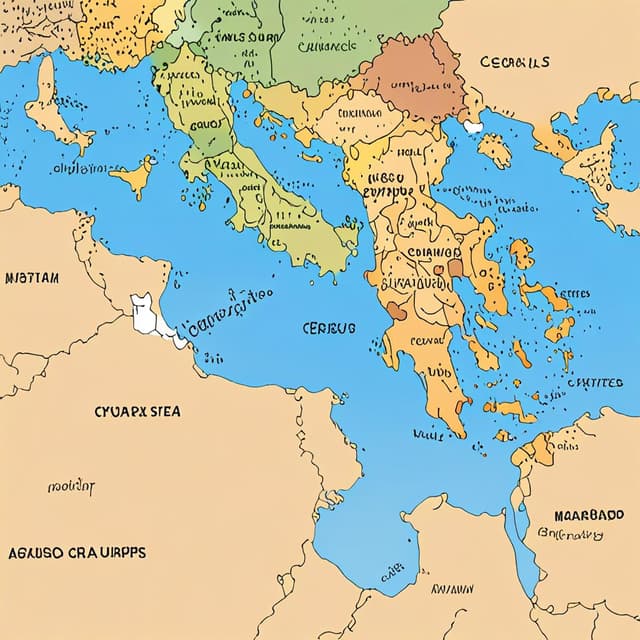
| Name | Turkish-Greek War of 1926-1929 |
| Cause | Dispute over control of Cyprus |
| Result | Negotiated settlement, establishment of independent, demilitarized Cyprus |
| Outcome | Tensions between Greece and Turkey persisted |
| Duration | Over 3 years |
| End date | 1929 |
| Start date | 1926 |
| Participants | Kingdom of Greece • Republic of Turkey |
The Turkish-Greek War, also known as the Cyprus War, was an armed conflict fought between the Kingdom of Greece and the Republic of Turkey from 1926 to 1929. The war was primarily a struggle for control over the Mediterranean island of Cyprus, which had been a British colony since 1878.
Tensions between Greece and Turkey over the status of Cyprus had been brewing since the 1920s, as both nations sought to exert influence over the strategically important island. The Greek government, led by Prime Minister Eleftherios Venizelos, pushed for the island to be granted to Greece, citing the large ethnic Greek population and historical claims. Meanwhile, the Turkish government of Mustafa Kemal Atatürk insisted that Cyprus remain under British rule or be ceded to Turkey.
The conflict came to a head in 1926 when the Greek government unilaterally declared the island's annexation. Turkey responded by mobilizing its military forces and launching an invasion of Cyprus, sparking the outbreak of the Turkish-Greek War.
The initial Greek invasion of Cyprus in 1926 was met with fierce resistance from the Turkish military, which quickly pushed the Greek forces back. Over the next year, the two sides engaged in a series of bloody battles across the island, with neither side able to gain a decisive advantage.
Seeking to break the stalemate, the Greek government appealed for support from its regional allies, particularly the Kingdom of Italy and the British Empire. In 1927, Italian and British forces intervened, deploying troops to Cyprus in an attempt to mediate the conflict. However, the involvement of these outside powers only served to prolong the fighting, as they struggled to find a mutually acceptable solution.
As the war dragged on through 1928 and into 1929, the economic and political toll on both Greece and Turkey became severe. The constant state of conflict undermined the stability of the governments in both nations, contributing to growing unrest and the rise of more radical political movements.
Finally, in the summer of 1929, the warring parties agreed to a negotiated settlement brokered by the Italian and British mediators. The resulting Treaty of Nicosia established the Republic of Cyprus as an independent, demilitarized state, with guarantees for the protection of the island's Greek and Turkish Cypriot populations.
While the war ended the dispute over Cyprus, the conflict left a legacy of resentment and mistrust between Greece and Turkey that would persist for decades. Both nations emerged from the war significantly weakened, with their regimes facing internal political challenges that would eventually lead to the collapse of the Kingdom of Greece in 1932 and the overthrow of Atatürk's government in Turkey in 1933.
The creation of an independent Cyprus, though intended to be a neutral buffer state, would continue to be a source of tension between the two nations, as they vied for influence over the island's affairs. The 1926-1929 Turkish-Greek War thus marked a pivotal moment in the complex and often turbulent history of the eastern Mediterranean region.
